

Managing Contacts
What is a contact?
A contact is an individual person in your FlowQi CRM — a customer, prospect, or supplier. Each contact has its own record with a name and details, email addresses, phone numbers, addresses, linked organizations, labels, tasks, and projects.
You might call them people, contact persons, or customers — in FlowQi an individual person is a contact. A contact can exist on its own; linking it to an organization is optional.
Where to find Contacts
In the left sidebar, click Contact. You’ll see your recent contacts and a View All Contact button that opens the full contacts overview.
The contacts overview
The list shows the following columns per contact:
| Column | Content |
|---|---|
| Name | First and last name (click to open the contact) |
| Organization(s) | Linked organizations |
| Job Title | The person’s role |
| The primary email address | |
| Phone | The primary phone number |
| Country | The contact’s country |
| Circle | The circle the contact is visible in |
| Labels | Assigned labels |
At the top of the list you can:
- Search — type in the search bar to search contact data.
- Filter by status — All, Active, Archived, or Inactive.
- Sort — by Name, Owner, or Country.
Adding a contact
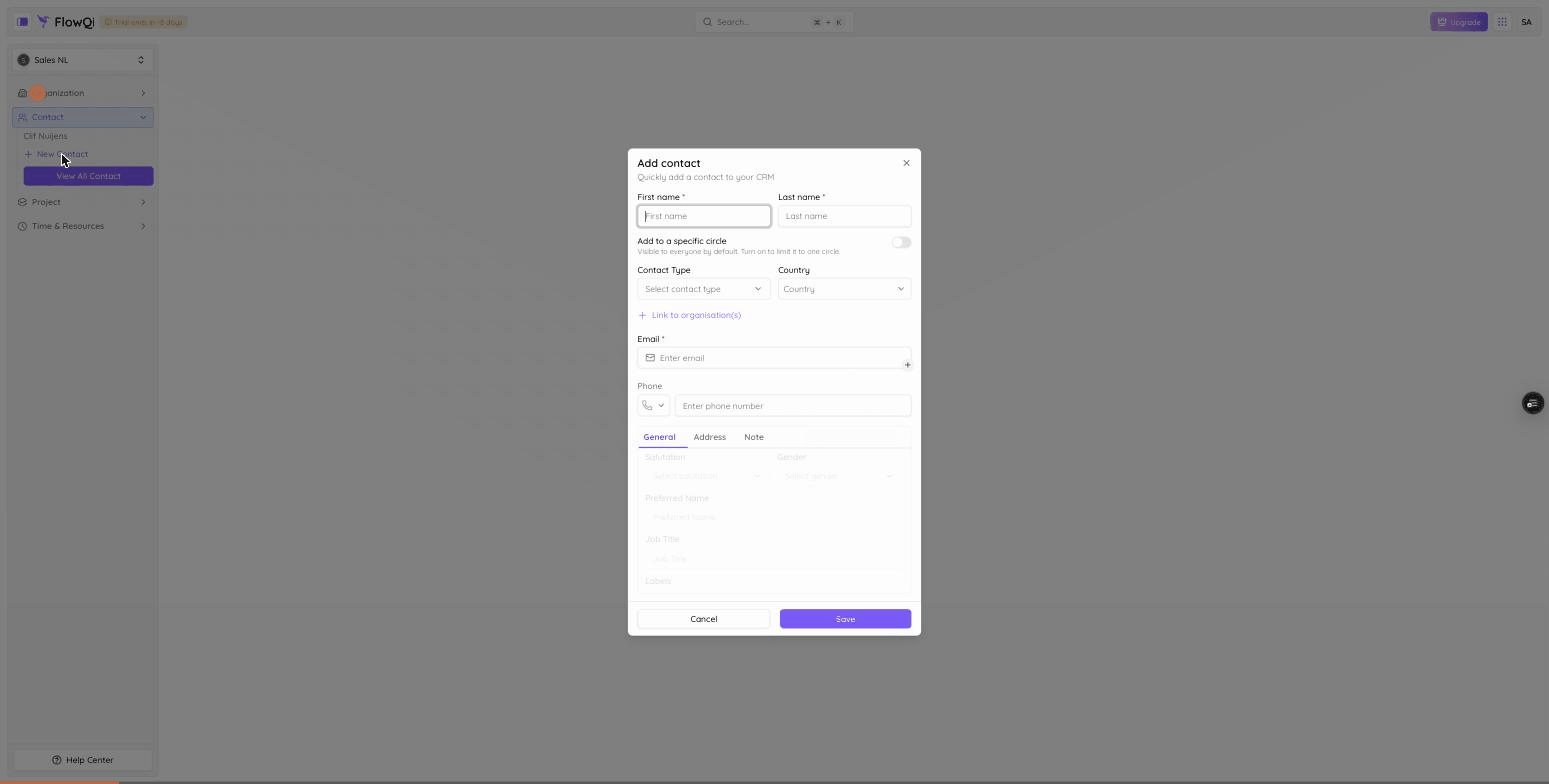
- Click Add Contact (top right), or Create Contact in the sidebar.
- In the Add contact dialog, only three fields are required:
- First name
- Last name
- Optionally fill in the rest:
- Add to a specific circle — off by default (the contact is visible to everyone); turn it on to limit the contact to one circle.
- Contact type — Customer, Prospect, or Supplier
- Country and phone number
- Link to organization(s)
- Under the General tab: salutation, gender, preferred name, job title, and labels
- Under the Address and Note tabs: address details and a free-form note
- Click Save.
Enter phone numbers in international format, starting with a country code — for example +31612345678.
Editing a contact
- Open the contact by clicking its name.
- Click the gear icon (settings) in the header.
- Choose a section in the side menu:
- General — name, job title, preferred name, contact type, gender, salutation, country, organizations, circle, and labels
- Contact — email addresses and phone numbers (drag to set order / primary)
- Address — addresses
- Notes — free-form notes
- Click Save changes.
Linking to organizations
Link a contact to one or more organizations through the Organizations field — when creating the contact or later under General. You can pick existing organizations or create a new one on the spot.
A contact and the organization you link it to must be in the same circle (or in your organization’s default circle). This keeps data from leaking between circles.
Labels
Labels help you categorize contacts (e.g. “VIP” or “Newsletter”). Add them through the Labels field — when creating the contact or under General. If a label doesn’t exist yet, you can create it on the fly.
Status: active, inactive, or archived
A contact has a status: Active, Inactive, or Archived. Use the status filter at the top of the overview to switch between them. Archiving is described in detail below.
Archiving, deleting & restoring
FlowQi keeps three distinct states so you never lose data by accident. Deleting no longer just hides a contact — deleted contacts go to a recoverable Trash, and only a true purge removes them for good.
| State | What it means | How to undo it |
|---|---|---|
| Archived | Done with the contact, but you want to keep it. It’s hidden from the active list and from pickers, and becomes read-only — but its data stays intact. | One click to Unarchive and bring it back. |
| In Trash (deleted) | Removed from your views but still fully recoverable. It sits in the Trash bin. | Restore it from Trash, or remove it for good. |
| Purged | Permanently deleted — the contact and its data are gone. Only possible from Trash. | Cannot be undone. |
Archiving a contact
Open the contact, click the gear icon, and in the General section use the Archive panel. An archived contact shows a banner reading “This contact is archived and read-only. Unarchive it to make changes.” — click Unarchive there or in the same panel to restore it.
To find archived contacts again, click Show archived at the top of the overview (or set the status filter to Archived).
Deleting a contact (move to Trash)
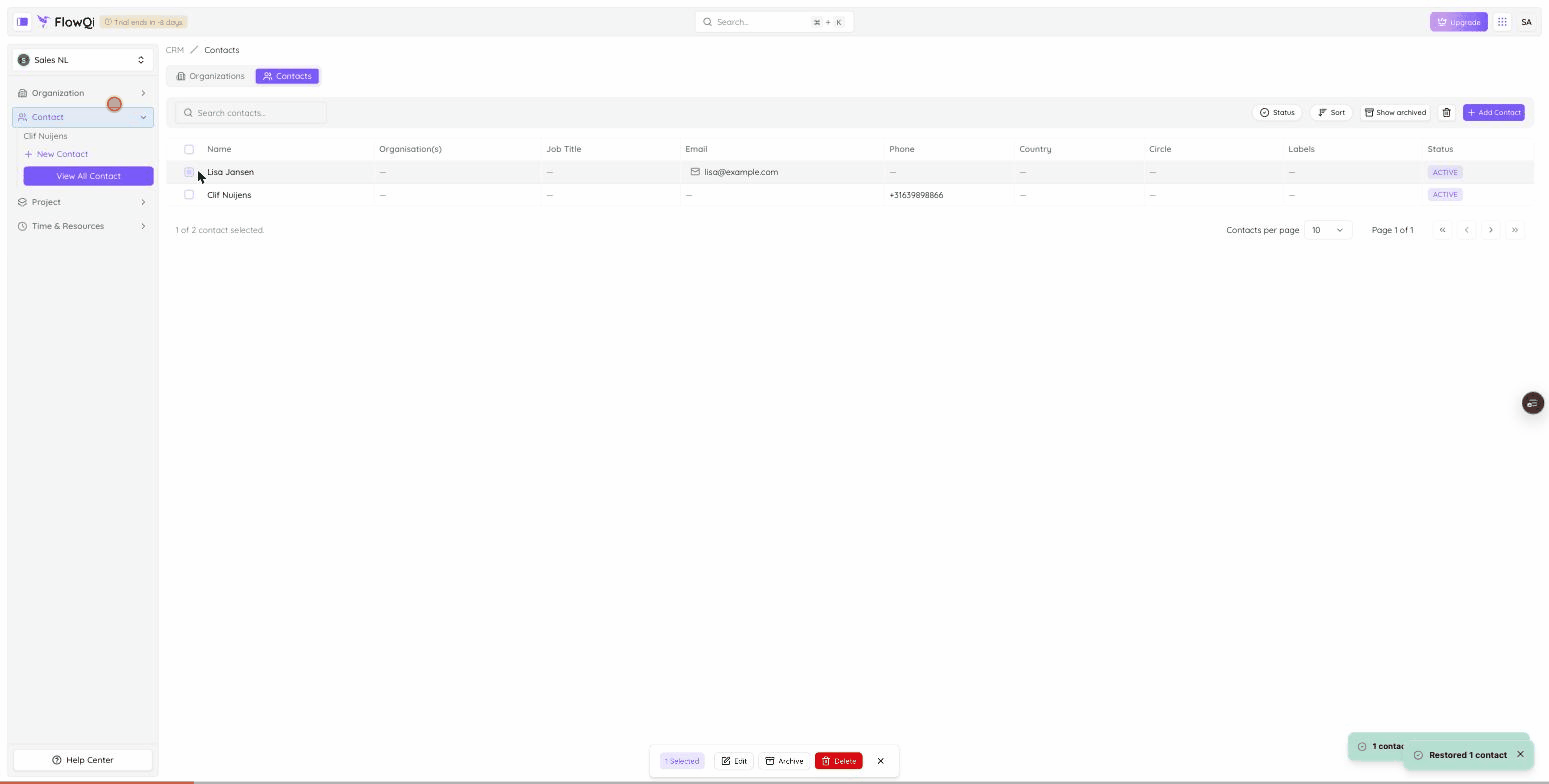
- In the overview, select one or more contacts with the checkboxes.
- In the action bar at the bottom, click Delete.
- Confirm in the dialog.
The contact moves to Trash rather than disappearing for good. Trash records who deleted each item and when.
Restoring or permanently deleting from Trash
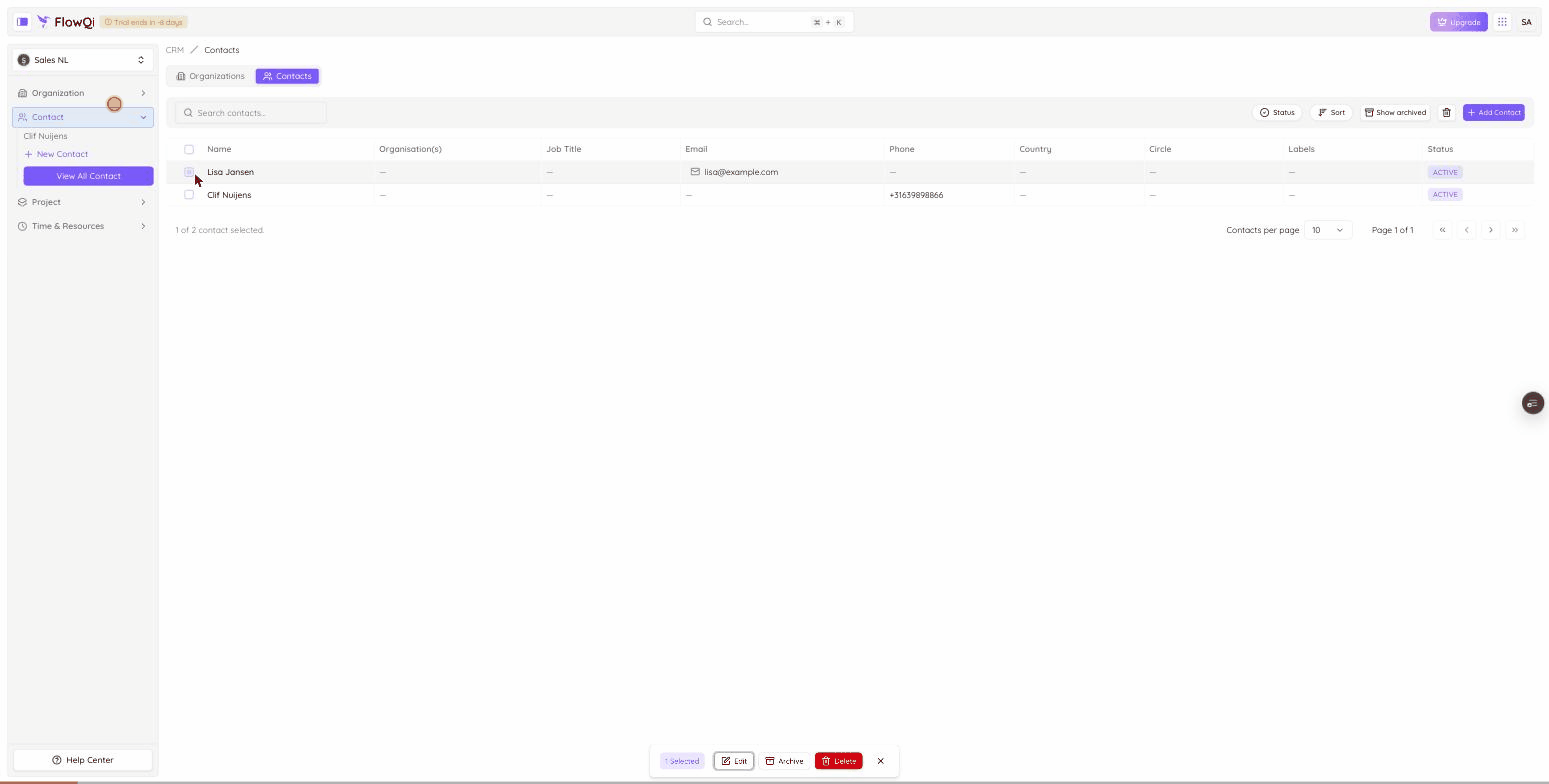
- At the top of the overview, click Trash.
- In the Trash — Contacts dialog, select one or more rows.
- Click Restore to bring them back, or Delete permanently to purge them.
Purging cannot be undone. Permanently deleting asks you to confirm by typing first, and warns that the action cannot be undone. If you’re not sure, archive the contact or leave it in Trash instead.
Permanently deleting (purge) is permission-gated — not everyone who can delete can purge. See Trash, archive & recovery for how these permissions and the recovery model work across FlowQi. The same Trash, archive, and restore flow applies to organizations .
Permissions
What you can do with contacts depends on your role. There are separate permissions for viewing, creating, editing, archiving, deleting, restoring, and permanently deleting (purging) contacts, and these can apply to all contacts, only your own, or your team’s. If you don’t see a button (e.g. + New contact or Delete permanently), you’re missing the matching permission — ask your administrator.
A contact’s detail page
When you open a contact, the header has tabs to related information:
- Tasks — tasks linked to this contact
- Projects — this contact’s projects
- Organization — the linked organizations